
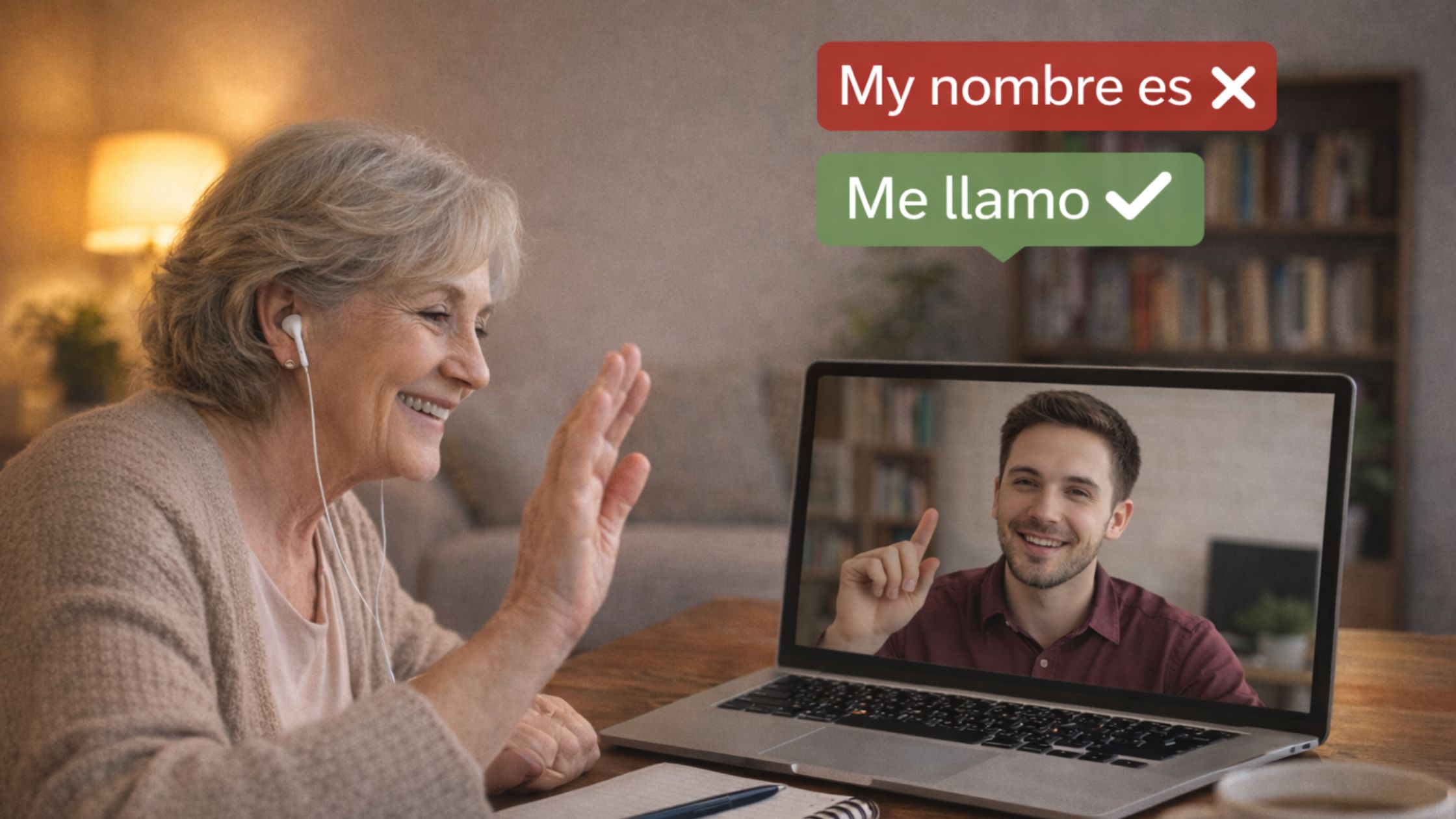
The 7 sounds that reveal you're an English speaker and how expert coaching fixes them
You know the words. You understand the grammar. You can read Spanish comfortably.
But when you speak, something feels off.
Native speakers pause before responding. They ask you to repeat yourself. Or worse, they switch to English to make things easier.
The problem is not your vocabulary. It is not your grammar. It is your pronunciation.
And here is what most learners do not realize: pronunciation mistakes are predictable. English speakers make the same errors, in the same patterns, for the same reasons. These mistakes do not disappear with time. They become fossilized unless someone corrects them early.
Why Pronunciation Is Harder Than Grammar
Grammar can be studied. Pronunciation must be heard, felt, and corrected in real time.
You cannot learn the Spanish "r" from a textbook. You cannot master vowel sounds from an app. You need someone listening to you, identifying what your mouth is doing wrong, and guiding you to the correct sound.
This is why learners who study alone often plateau. They understand Spanish perfectly but speak it with an accent so thick it creates barriers. Pronunciation is not about perfection. It is about clarity.
Research shows that mastering Spanish pronunciation requires focused practice on the specific sounds that do not exist in English—sounds your ear needs to be trained to hear before your mouth can produce them.
1. The Rolled R (and the Flapped R)
This is the sound English speakers fear most. And for good reason.
Spanish has two different R sounds. The single-tap flap (as in pero) and the rolled trill (as in perro). English speakers substitute both with the English "r" sound, which does not exist in Spanish.
The result? Pero (but) and perro (dog) sound identical. Caro (expensive) and carro (car) become the same word. Meaning collapses.
Why It Happens:
English uses the back of the tongue for "r." Spanish uses the tip of the tongue against the roof of the mouth. Your mouth is in the wrong position from the start.
How to Fix It:
The flapped R is easier. It is the same tongue movement as the "tt" in "butter" or "ladder" in American English. Start there. The rolled R requires vibration. It takes repetition, correction, and patience. A teacher can hear when you are close and guide you to the right tension.
2. Pronouncing Vowels Like English Vowels
English has more than a dozen vowel sounds. Spanish has five. And they never change.
English speakers drag vowels, diphthongize them, and shift their quality mid-sound. In Spanish, vowels are short, crisp, and consistent. When you pronounce Spanish vowels like English vowels, every word sounds mushy.
Common Mistakes:
A: English speakers say "ay" (as in "day"). Spanish A is always "ah" (as in "father").
E: English speakers say "ee" (as in "see"). Spanish E is "eh" (as in "bet").
I: English speakers relax it. Spanish I is always a sharp "ee" (as in "see").
O: English speakers say "oh" with a glide. Spanish O is pure "oh" (as in "go" but shorter).
U: English speakers say "uh" or "yoo." Spanish U is always "oo" (as in "boot").
Why This Matters:
Vowels carry meaning in Spanish. Pronounce them incorrectly and words blur together. Native speakers will understand you, but they will also immediately recognize you as a non-native speaker.
3. Adding Extra Syllables to Words Starting with "S"
English does not allow words to start with certain consonant clusters. Spanish does.
English speakers unconsciously add an "e" sound before words like escribir, español, or escuela. They say "es-cribir" as "es-cribir" but with an invisible "eh" before it.
Example:
España becomes "eh-SPAN-ya" instead of "es-PAHN-ya."
How to Fix It:
Practice saying the "s" sound immediately. No warm-up vowel. No preparation. Just "s" into the consonant that follows. It feels abrupt at first, but that is how Spanish works.
4. Mispronouncing the Letter J (and the Soft G)
The Spanish J is not the English J. It is not even close.
English speakers say "J" as in "jump." Spanish J is a guttural sound from the back of the throat, similar to the "ch" in the Scottish "loch" or the German "Bach."
Words Affected:
Jugar (to play), rojo (red), reloj (clock), and any word with ge or gi like general or gente.
Why English Speakers Struggle:
English does not have this sound. Your throat is not used to making it. Without a teacher modeling it and correcting your attempts, you will default to the English "h" or "j" sound indefinitely.
5. Stressing the Wrong Syllable
Spanish stress patterns are rule-based. English speakers ignore the rules and stress syllables based on English intuition.
The result sounds unnatural, even when the individual sounds are correct.
Spanish Stress Rules:
If a word ends in a vowel, N, or S: stress the second-to-last syllable (ca-SA, ha-BLAN).
If a word ends in any other consonant: stress the last syllable (ha-BLAR, ciu-DAD).
If there is a written accent mark: stress that syllable (MÚ-si-ca, es-PA-ÑOL).
Common Mistakes:
English speakers stress teléfono on the wrong syllable. They say computaDORA instead of compuTAdora. Each mistake signals unfamiliarity.
6. Pronouncing D and T Too Harshly
English D and T are explosive. Spanish D and T are soft.
In Spanish, the tongue touches the back of the top teeth, not the roof of the mouth. The sound is gentler. English speakers use too much force and the words sound aggressive.
Particularly Noticeable in:
Words like todo, nada, tarde, and dos. The D between vowels should be soft, almost like the "th" in "father."
Why It Matters:
This is one of the clearest markers of an English accent. Soften your D and T, and you immediately sound more natural.
7. Ignoring the Ñ Sound
English speakers either skip the ñ entirely or pronounce it as a regular "n."
The ñ is not optional. It changes meaning. Ano (anus) versus año (year). Peña (rock) versus pena (sorrow). The tilde is not decoration.
How to Pronounce It:
The ñ sounds like the "ny" in "canyon" or "lasagna." Your tongue flattens against the roof of your mouth while you push air through your nose.
Why English Speakers Struggle:
This sound does not exist as a single letter in English. It requires conscious effort to produce. Without correction, learners will avoid it or mispronounce it forever.
Why Apps and Videos Cannot Fix Pronunciation
Apps can show you mouth diagrams. Videos can demonstrate sounds. But neither can listen to you.
Pronunciation is personal. Your mouth has habits shaped by decades of speaking English. Those habits do not disappear from watching a video. They disappear when someone listens to you speak, identifies the specific error, and guides you to the correction.
Language learning research confirms that corrective feedback from instructors is one of the most effective tools for improving pronunciation—far more effective than self-study or passive listening.
How Pronunciation Actually Improves
Pronunciation improves through repetition, correction, and real-time feedback.
A teacher hears what you say, understands what you meant to say, and shows you how to bridge the gap. This happens in conversation, not in exercises. It happens when someone cares enough to interrupt you and fix the mistake before it becomes permanent.
I have taught thousands of students over two decades. The ones who improve fastest are not the ones who study hardest. They are the ones who receive consistent, personalized correction.
Pronunciation Shapes How People Perceive Your Spanish
Native speakers will forgive grammar mistakes. They will overlook limited vocabulary. But pronunciation creates the first impression.
When your pronunciation is clear, people relax. Conversations flow. Doors open. When your pronunciation is unclear, people hesitate. They switch to English. They assume you are a beginner, even if you are not.
Pronunciation is not vanity. It is communication.
Learning Spanish Pronunciation With a Teacher Who Listens
JustSpanish was built for learners who want to sound natural, not just correct. All lessons are private and online. Pronunciation is taught through conversation, corrected in real time, and reinforced until it becomes automatic.
Our tutors listen to how you speak, identify the patterns holding you back, and guide you step by step to clearer, more confident Spanish.
If you are tired of being misunderstood and ready to sound like you actually know Spanish, start learning Spanish pronunciation with private lessons at JustSpanish.
Ready to Sound Like a Confident Spanish Speaker?
Stop guessing at sounds. Get real-time feedback from an experienced teacher who will correct your pronunciation as you speak.