
Spanish Grammar Mistakes Beginners Always Make (And How to Fix Them)
Learn the 5 most common errors that hold beginners back—and the teaching approach that eliminates them for good
You studied the vocabulary. You memorized the verbs. You completed the exercises.
Then you tried to speak.
What came out did not sound right. You knew the words, but the sentence felt wrong. The person listening understood you, but only after effort. And you walked away unsure if what you said was correct.
This is how most beginners experience Spanish grammar. Not as a lack of effort, but as a lack of clarity. Grammar mistakes are not random. They follow predictable patterns. And unless someone explains those patterns to you early, they become habits that are hard to break.
Why Beginner Grammar Mistakes Persist
Most beginners assume grammar mistakes disappear with time. They believe exposure alone will fix them. But grammar does not correct itself. It reinforces itself.
If you repeat the same incorrect structure often enough, it starts to feel natural. This is why beginners who rely only on apps or self-study often sound the same after months or even years. The errors become part of their Spanish.
Grammar mistakes are not a sign of failure. They are a sign of missing explanation. And when children learn a second language early, they develop stronger cognitive flexibility that helps them avoid these patterns—research shows that learning a second language benefits kids in ways that extend far beyond communication.
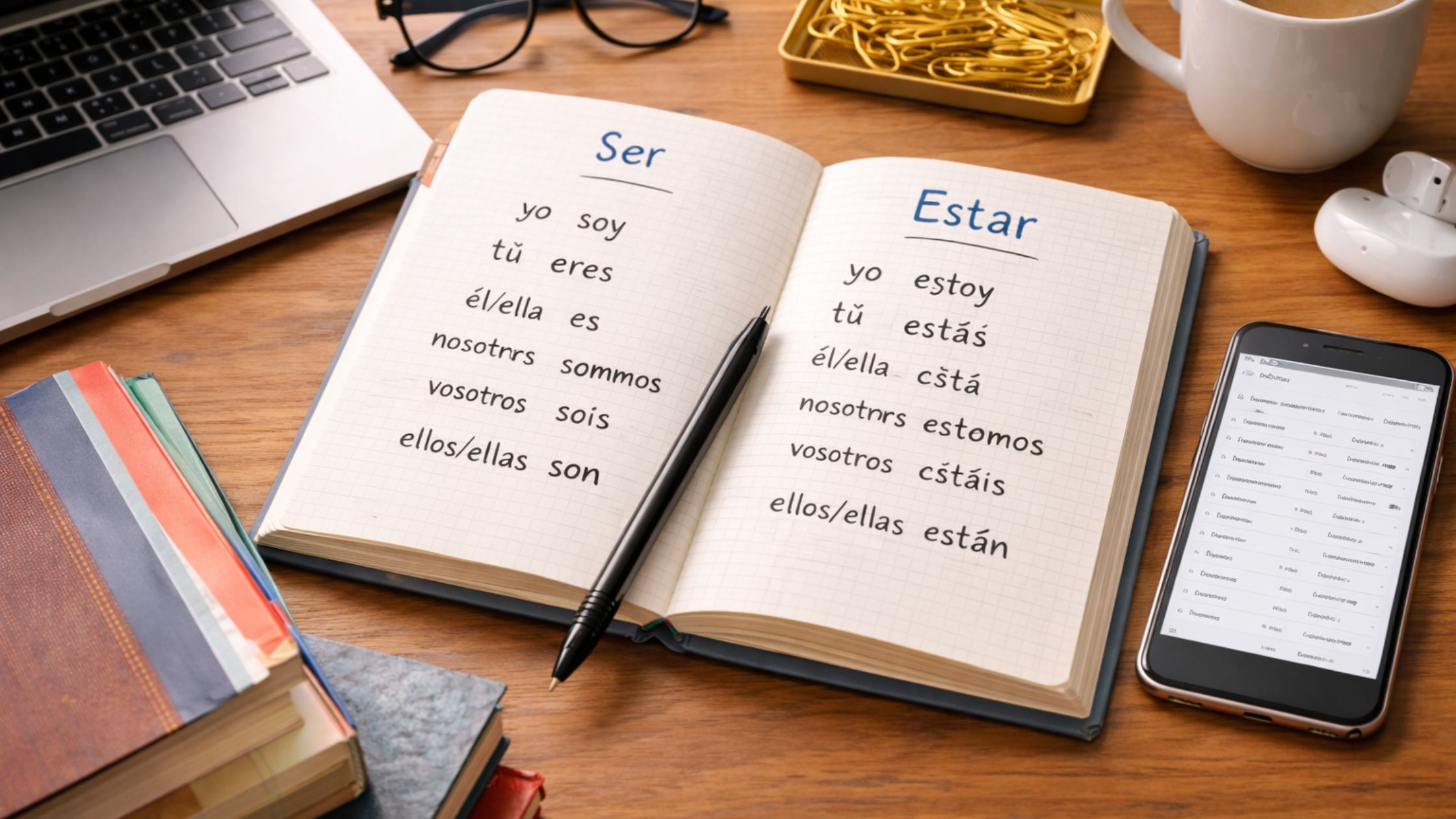
1. Confusing Ser and Estar
This is the most famous mistake in Spanish and also the most misunderstood.
Beginners are told that ser is permanent and estar is temporary. This explanation is convenient, but incomplete. It leads to confusion almost immediately.
Why is someone dead permanently but described with estar? Why is a city location described with estar when it's permanent? Why do we say someone is nervous with estar but intelligent with ser?
Without a teacher explaining how Spanish categorizes identity versus condition, students guess. Guessing leads to hesitation. Hesitation leads to silence.
Ser and estar are not opposites. They are perspectives. Until that perspective is explained clearly, mistakes continue.
2. Using English Sentence Structure in Spanish
English word order feels invisible to native speakers. We do not notice it until we try to apply it to Spanish.
Beginners often translate directly. The result sounds understandable but unnatural. Adverbs land in the wrong place. Object pronouns appear too late. Emphasis falls on the wrong word.
Spanish is not English with different vocabulary. It is a different system of organizing meaning. Learning grammar means learning how Spanish thinks, not how English translates.
Common Example:
English: "I always eat breakfast at 8am."
Incorrect Spanish: "Yo siempre como desayuno a las 8."
Correct Spanish: "Siempre desayuno a las 8."
3. Ignoring Gender Agreement
Many beginners treat gender as decoration. Something optional. Something secondary.
In Spanish, gender is structural. Articles, adjectives, and nouns communicate together. When they do not agree, the sentence feels unstable.
This is not about memorizing rules. It is about learning to hear agreement. That skill only develops when mistakes are corrected in real time and explained clearly.
4. Misusing Verb Tenses Too Early
Beginners are often introduced to too many tenses too quickly. Past, future, conditional, subjunctive. The result is confusion.
Instead of mastering a small set of core structures, learners jump between forms without understanding why one is chosen over another.
Grammar works best when it is layered. Each tense builds on the logic of the previous one. When that sequence is broken, mistakes multiply.
5. Skipping the Personal "A"
English doesn't have this feature, so beginners often forget it entirely. In Spanish, when the direct object of a verb is a specific person (or pet), you must use the personal "a" before it.
Without this small word, sentences sound incomplete to native speakers—even if the meaning is technically clear.
Example:
Incorrect: "Veo mi madre."
Correct: "Veo a mi madre." (I see my mother.)
Why Apps Do Not Fix Grammar Errors
Apps identify mistakes. They do not explain them.
A sentence is marked wrong. A correct version appears. The learner moves on.
What is missing is the reason. Why this structure works. Why the other does not. How to recognize the same error next time.
Grammar is not a multiple choice problem. It is a thinking process.
How Grammar Is Actually Learned
Grammar improves when a teacher listens to what you say, understands what you meant, and shows you how Spanish expresses that idea.
Correction must be immediate and personal. Explanation must match the learner. Structure must be intentional.
I have spent decades teaching Spanish to adults. I have worked with learners from every background and every age group. One thing is always true: grammar clicks when someone guides the learner through it step by step.
This approach has been recognized internationally. The teaching philosophy behind it has been featured in The New York Times for its focus on clarity, correction, and human connection.
Fixing Grammar Mistakes Early Changes Everything
When grammar mistakes are addressed early, confidence grows faster. Speaking becomes easier. Listening improves. Progress accelerates.
When mistakes are ignored, learners plateau. They understand more but speak less. They hesitate. They second-guess themselves.
Spanish grammar is not difficult. It is precise. Precision requires explanation.
Start Learning Spanish Grammar With Expert Guidance
JustSpanish was created for learners who want to understand Spanish, not guess at it. All lessons are private and online. Grammar is taught in context, explained clearly, and reinforced through conversation.
Our tutors correct mistakes as they happen and explain why the correction matters. This prevents bad habits and builds strong foundations.
If you want to stop repeating the same grammar mistakes and start speaking with confidence, learn Spanish online with private lessons at JustSpanish.
Ready to Fix Your Spanish Grammar?
Stop guessing and start speaking with confidence. Book your first private lesson today.